The mortgage industry is constantly changing, and lenders need more than their own production numbers to understand how their business is performing. Interest rates, housing inventory, borrower demand, and competitor activity all influence where mortgage opportunities exist. While tracking loan volume and funded transactions provides valuable information, these numbers only tell part of the story. A lender may be increasing production while losing ground to competitors or maintaining a strong position in a market where overall activity is declining.

The mortgage industry is constantly changing, and lenders need more than their own production numbers to understand how their business is performing. Interest rates, housing inventory, borrower demand, and competitor activity all influence where mortgage opportunities exist. While tracking loan volume and funded transactions provides valuable information, these numbers only tell part of the story. A lender may be increasing production while losing ground to competitors or maintaining a strong position in a market where overall activity is declining.
Mortgage market share analysis provides a clearer picture of how lenders compare to the broader market. By examining origination activity, competitor performance, and geographic trends, lenders can better understand where they stand and where opportunities for growth may exist. Rather than relying on assumptions about which markets are performing well, leadership teams can use mortgage market intelligence to evaluate their competitive position and make informed decisions.
Understanding market share is not simply about identifying the largest lenders or the busiest markets. It is about recognizing changes in the competitive landscape, identifying areas of opportunity, and determining where business efforts can have the greatest impact.
Mortgage market share represents the percentage of mortgage activity a lender captures within a defined market over a specific period. This can be measured using the total number of loans originated or the dollar volume of those loans. The calculation compares a lender’s production against the total production recorded within the same market, allowing lenders to understand their relative position.
For example, if a county records 10,000 mortgage originations during a year and one lender originates 500 of those loans, that lender holds a 5% share based on loan count. However, market share calculated by dollar volume may tell a different story. A lender originating fewer loans with higher average loan amounts could hold a larger percentage of the market’s total dollar volume.
The boundaries of the analysis also matter. A lender might hold a significant share of conventional purchase loans within one county but have a much smaller presence across the entire state. Similarly, a lender’s position in the refinance market may differ considerably from its position in purchase lending.
Mortgage market share analysis becomes more meaningful when lenders compare similar loan categories, geographic areas, and reporting periods. These comparisons help prevent misleading conclusions and provide a more accurate understanding of competitive performance. Market share should not be viewed as the only measure of success, but it offers important context that internal production reports cannot provide on their own.
Increasing mortgage production is generally a positive development, but higher loan volume does not automatically mean a lender is becoming more competitive. The overall market may be growing faster than the lender’s business, allowing competitors to capture a greater percentage of available opportunities.
Consider a lender that originated $100 million in loans during one year and increased production to $120 million the following year. At first glance, this represents a 20% increase in production. However, if total mortgage originations in that market increased from $1 billion to $1.5 billion during the same period, the lender’s market share actually declined from 10% to 8%.
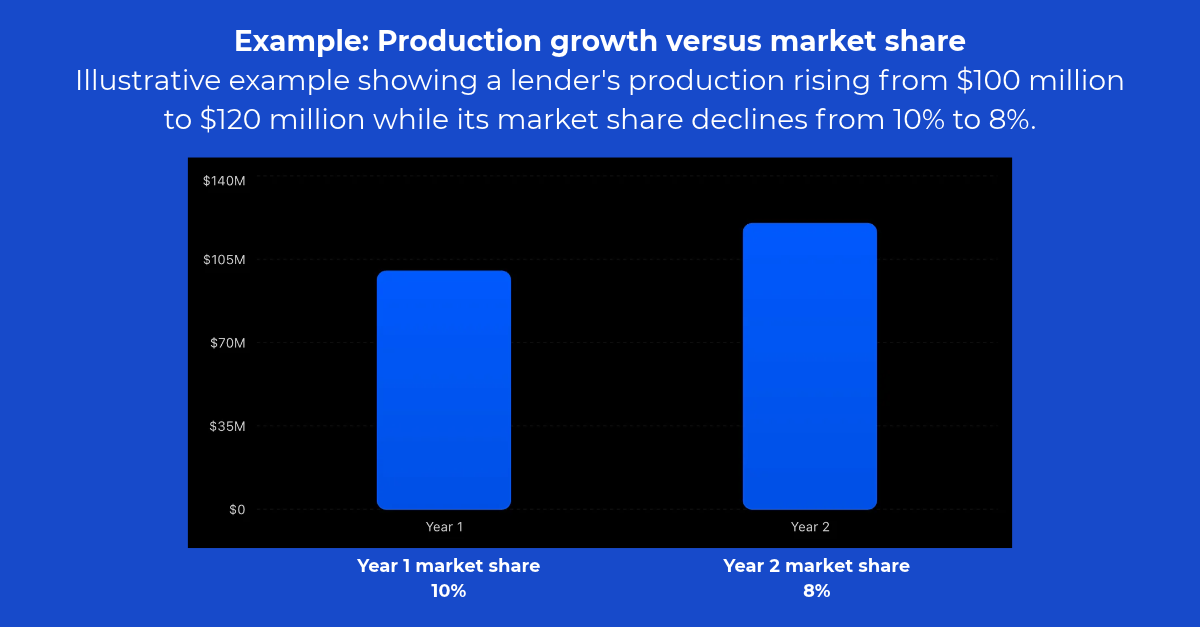
Illustrative figures, not actual mortgage market data.
The opposite situation can also occur. A lender experiencing a decline in production may still be gaining mortgage market share if overall market activity is falling at a faster rate. This distinction is especially important during periods of changing interest rates, limited housing inventory, or reduced refinance demand.
By comparing internal results against total market activity, lenders can better determine whether changes in production reflect their own performance or conditions affecting the entire industry. This broader perspective helps leadership teams evaluate progress more accurately and avoid making decisions based on incomplete information.
National lender rankings provide a useful overview of the mortgage industry, but they do not always reflect the competitive conditions within individual markets. A lender with a relatively small national presence may be one of the leading mortgage providers in a particular county or metropolitan area. Meanwhile, a nationally recognized lender may have limited activity in that same location.
Understanding these differences requires mortgage competitor analysis that goes beyond national production totals. By evaluating lending activity at the state, county, and ZIP code levels, lenders can identify which institutions are capturing business in the markets that matter most to their operations.
Local analysis can reveal competitive patterns that broader reports overlook. For example, a lender may discover that several regional institutions consistently originate a large percentage of purchase loans within a particular county. Another market may be dominated by national lenders, while neighboring communities show a more balanced distribution of mortgage activity.
These differences can influence how lenders evaluate potential growth opportunities. A market with substantial origination activity may appear attractive, but the level of competition and the types of loans being originated are equally important considerations. Understanding who is active in a market helps lenders determine whether their products, services, and business capabilities align with local demand.
Geographic comparisons also help lenders recognize where their existing presence is strongest. Rather than evaluating every location using the same expectations, leadership teams can establish a clearer picture of how competitive conditions vary across the areas they serve.
Changes in competitor market share can reveal important developments within a local mortgage market. When a lender consistently increases its percentage of originations in a particular area, that movement may indicate changing borrower demand, stronger distribution, new product offerings, or other competitive factors worth examining.
Tracking these changes over time allows lenders to move beyond a single snapshot of market activity. A competitor experiencing one strong quarter may simply be benefiting from temporary conditions. However, sustained growth across several reporting periods can suggest a more meaningful change in the competitive landscape.
Mortgage market share analysis can also help identify locations where a lender has a limited presence despite significant origination activity. For example, a lender operating successfully in several neighboring counties may discover that an adjacent market has comparable mortgage demand but relatively little production from its own organization. That difference could justify further research into local competition, borrower needs, and potential business opportunities.
However, limited market share does not automatically mean an area is underserved or suitable for expansion. A lender must also consider factors such as existing competition, loan product demand, operational capacity, and the costs associated with entering or expanding within a market.
The value of this analysis comes from asking better questions. Why are certain competitors gaining ground? Which markets are experiencing meaningful changes in origination activity? Are those changes concentrated in specific loan products or geographic areas? By exploring these questions, lenders can identify opportunities based on measurable market conditions rather than assumptions.
A lender’s overall mortgage market share may conceal important differences across individual loan products. Purchase loans, refinances, conventional mortgages, FHA loans, and VA loans can each represent different competitive environments. Understanding these distinctions provides a more detailed view of where a lender is performing well and where additional opportunities may exist.
For example, a lender may hold a strong position in conventional purchase lending while capturing a relatively small percentage of FHA originations in the same market. Another lender may generate substantial refinance volume but have a limited presence among purchase borrowers. These differences can reveal how a lender’s existing product offerings align with local demand.
Product-level analysis also helps lenders understand which types of financing are driving market activity. In some areas, conventional loans may account for the majority of originations. In others, government-backed loan programs may represent a larger portion of available business. Changes in housing affordability, borrower qualifications, and financing needs can influence these patterns over time.
Mortgage competitor analysis becomes more useful when lenders evaluate market share within comparable loan categories rather than relying entirely on combined production totals. This approach can help identify whether a lender’s competitive position is consistent across its offerings or concentrated in specific segments.
Any potential opportunity must still be evaluated against the lender’s capabilities, eligibility requirements, and business objectives. Expanding into a loan category simply because competitors are active does not guarantee success. However, understanding product-level differences can help lenders determine where additional research and resources may be worthwhile.
Mortgage lending trends play an important role in how market share changes over time. Interest rates, home prices, housing inventory, and borrower demand can all influence origination activity. As these conditions change, the types of loans being originated and the lenders capturing that business may change as well.
Periods of lower interest rates often create greater interest in refinancing, while purchase activity depends on factors such as affordability, available housing, and consumer confidence. These changes can affect lenders differently depending on their business models, geographic presence, and loan product offerings.
For this reason, evaluating mortgage market share requires an understanding of the conditions influencing overall lending activity. A lender specializing in refinance transactions may experience a different production pattern than one focused primarily on purchase mortgages. Comparing their performance without accounting for these differences could lead to misleading conclusions.
Historical data can help lenders recognize how their competitive position has changed through different market environments. By reviewing multiple reporting periods, leadership teams can identify patterns that may not be visible in a single month or quarter. Year-over-year comparisons can be particularly useful when evaluating seasonal changes in mortgage activity.
It is also important to recognize that historical trends do not guarantee future results. Market conditions can shift unexpectedly, and previous performance should be used as context rather than a prediction. Combining mortgage lending trends with geographic and competitive analysis provides a more complete understanding of the factors influencing market share.
Access to reliable mortgage data is an important part of evaluating competitive performance. Without a clear view of lender activity, production trends, and geographic markets, it can be difficult to determine where meaningful opportunities exist. Mortgage market intelligence helps bring these different pieces of information together so lenders can better understand the environment in which they operate.
Traditional approaches to market research may involve reviewing multiple reports, comparing spreadsheets, and gathering information from separate sources. While these methods can provide useful insights, they can also make it difficult to evaluate competitive changes consistently. Having relevant market information available through a centralized platform can make the research process more efficient.
MMI One DataCenter provides mortgage professionals with access to production information, lender intelligence, property research, and market insights. These capabilities help lenders examine activity across geographic markets, evaluate production patterns, and better understand the competitive landscape.
For example, lenders can use DataCenter to research mortgage production within specific markets and examine the activity of competing institutions. Geographic filtering allows teams to focus on the areas most relevant to their business, while production information provides additional context around lender performance.
Year-over-year comparisons can also help users recognize changes in activity over time. Rather than relying solely on current production totals, lenders can evaluate how results have shifted across reporting periods and identify patterns that deserve further attention.
Customizable widgets and views provide additional flexibility when reviewing relevant information. By organizing data around their research priorities, mortgage professionals can focus on the metrics that support their business objectives.
The purpose of mortgage market intelligence is not to replace leadership experience or guarantee increased production. Instead, it provides information that can support more informed decisions. When lenders understand where mortgage activity is occurring, how competitors are performing, and which markets are changing, they are better equipped to evaluate their next steps.
Identifying a potential growth opportunity is only the beginning. To make mortgage market share analysis valuable, lenders need to translate their findings into clear business priorities that can be evaluated over time. This requires connecting market research with realistic goals, available resources, and the organization’s broader objectives.
For example, a lender may identify a county where mortgage origination activity is increasing while its own market share remains relatively low. Rather than immediately expanding operations, leadership can investigate the factors influencing that market. Reviewing competitor activity, loan product demand, and historical production can help determine whether the opportunity aligns with the lender’s capabilities.
Market share findings can also support more realistic production goals. If a lender currently holds 4% of a defined market, leadership may evaluate what would be required to reach 5% over a future reporting period. However, that goal should account for expected market activity, historical performance, and operational capacity rather than relying on an arbitrary percentage increase.
Consistent measurement is equally important. Comparing market share across different geographic boundaries, loan categories, or reporting periods can create misleading results. Establishing a consistent approach to analysis allows lenders to evaluate changes more accurately and recognize whether their competitive position is improving.
Regular reviews also help organizations respond to changing conditions. A market that appeared attractive six months earlier may become more competitive, while another area may begin showing stronger origination activity. Monitoring these developments allows lenders to revisit their priorities as new information becomes available.
Ultimately, market share analysis should support thoughtful decision-making rather than encourage growth for its own sake. Understanding where a lender is positioned, what is changing, and which opportunities align with its capabilities can help create a more focused approach to business development.
Understanding mortgage market share requires looking beyond internal production reports and examining the broader competitive environment. Loan volume, geographic activity, competitor performance, and mortgage lending trends all contribute to a clearer picture of where a lender stands within the market. When these factors are evaluated together, lenders can better distinguish between changes in their own performance and shifts affecting the industry as a whole.
Mortgage market share analysis also helps organizations recognize opportunities that might otherwise remain hidden. A lender may discover that its strongest competitive position exists within a particular loan category, that a neighboring market deserves additional research, or that changes in competitor activity signal a shift in local lending conditions. These findings provide useful context for establishing priorities and evaluating future opportunities.
MMI One supports this process by providing access to mortgage intelligence and production insights through DataCenter. With the ability to explore lender activity, examine geographic markets, and review production information, mortgage professionals can approach market research with greater clarity.
Building a stronger competitive position begins with understanding the market, recognizing meaningful changes, and making decisions supported by relevant information. Rather than relying on assumptions about where business opportunities exist, lenders can use market intelligence to develop a more informed view of their competitive landscape.
Ready to gain a clearer understanding of your market? Book a demo of MMI One to explore how DataCenter can help you analyze mortgage activity, understand your competition, and identify opportunities for growth.


